
How Deep Do Tomato Roots Grow? Quick complete Guide (2026)
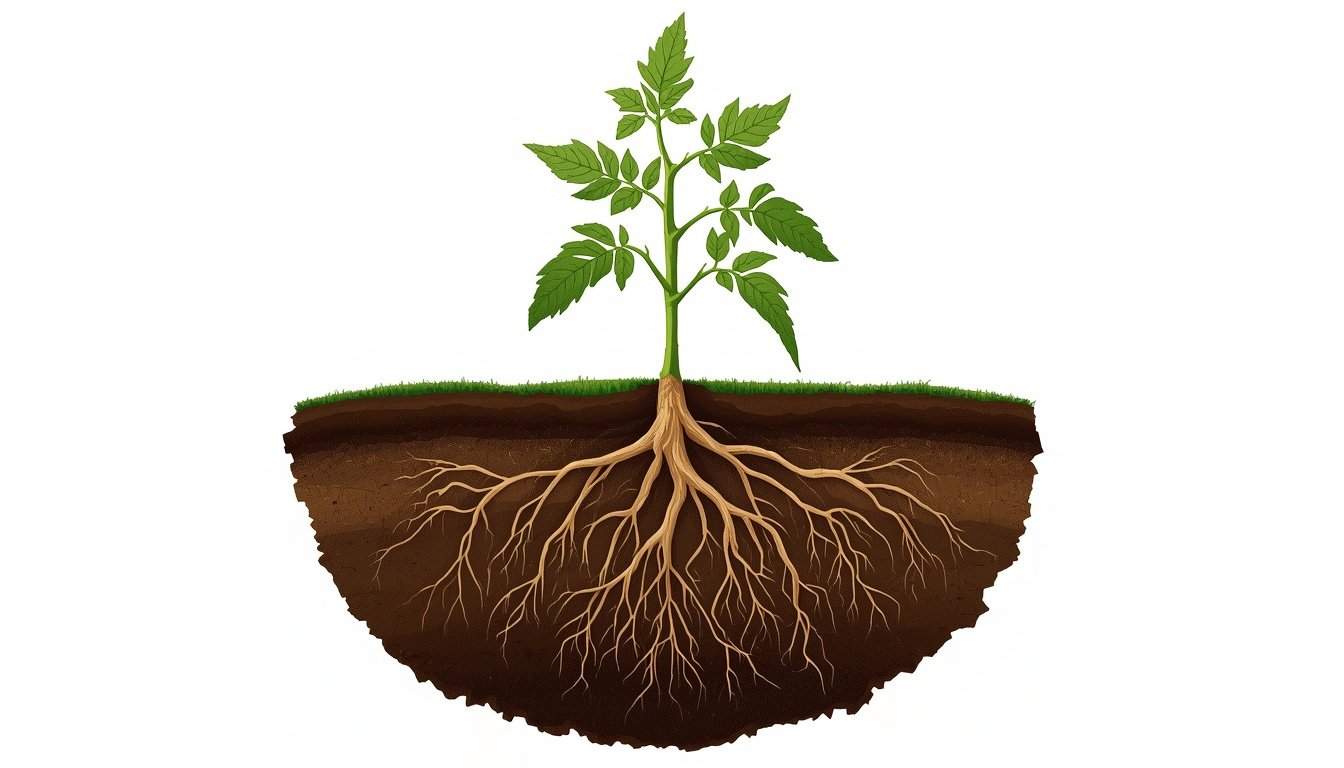
How deep do tomato roots grow depends on where you look. Most of a tomato plant’s active root mass stays within about two feet of the surface, while the root system as a whole is capable of reaching considerably deeper when the soil allows it.
Quick Answer
Tomato roots typically concentrate in the top 18 to 24 inches (46 to 61 cm) of soil, the zone responsible for most water and nutrient uptake. In loose, deep, well drained soil, individual roots can extend three feet (about 90 cm) or more. Container tomatoes are limited by pot depth, generally 10 to 24 inches depending on variety and container size.
Common Tomato Root Problems: Diagnostic Table
| Symptom Likely Root Cause Actionable Fix | ||
|---|---|---|
| Wilting despite consistently wet soil | Waterlogged, oxygen starved soil, early root rot | Improve drainage, allow the top few inches to dry between waterings, check for a compacted layer beneath the root zone |
| Plant dries out and wilts quickly after watering | Shallow root system from frequent light watering or an undersized container | Water more deeply and less often; increase container depth or move to a larger pot |
| Lower leaves yellowing, growth slowing | Compacted soil limiting root oxygen and nutrient access | Loosen soil only when it is dry, not wet; work in compost; avoid walking on the root zone |
| Stunted growth despite regular feeding | Root bound plant that has outgrown its container | Remove the plant, inspect the root ball, transplant to a larger pot, and loosen circling roots |
| Roots visible circling the pot or at drainage holes | Container outgrown, or seedling left too long before potting up | Pot up promptly, and gently loosen circling roots before replanting |
| Soggy soil with a sour smell near the roots | Poor drainage combined with root rot pathogens such as Pythium | Improve drainage immediately, reduce watering frequency, trim away soft or blackened roots |
| Poor recovery and wilting for several days after transplanting | Root disturbance during transplanting, ordinary transplant shock | Handle the root ball gently, water in thoroughly, provide brief shade for a day or two |
| Leggy, weak stemmed seedling | Shallow planting that does not use the stem’s adventitious rooting ability | Bury the stem deeper at transplant time, up to the first set of true leaves |
| Black, mushy, foul smelling roots | Advanced root rot from prolonged saturation | Remove affected roots and soil, correct drainage, and avoid replanting in the same waterlogged spot |
How Deep Do Tomato Roots Grow?
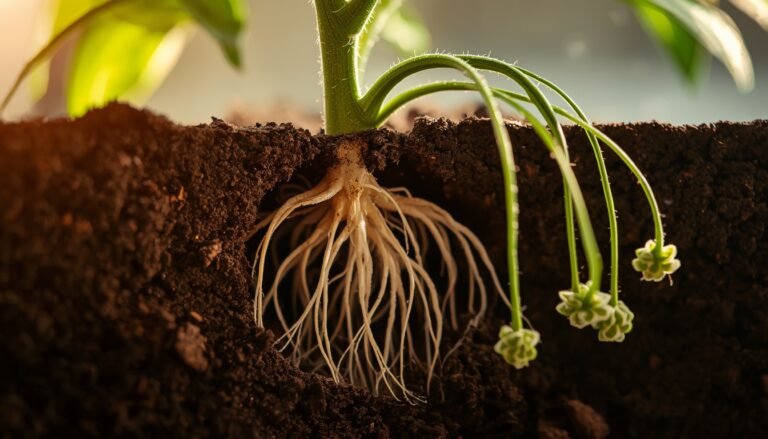
A tomato is not a single deep taproot plant like a carrot, and it is not a purely shallow, fibrous rooted plant either. Solanum lycopersicum begins with a taproot tendency that quickly gives way to an extensive, wide branching system, and most of the functional root mass ends up concentrated within the top two feet of soil rather than growing straight down.
That said, the root system as a whole is capable of exploring considerably more soil than the surface appearance suggests, provided the soil beneath is loose, aerated, and moist enough to be worth exploring. The sections below separate three distinct concepts that are frequently blurred together in gardening content: the effective root zone, the common practical depth a home gardener should plan around, and the documented maximum penetration recorded in historical excavation research.
How Tomato Roots Are Built
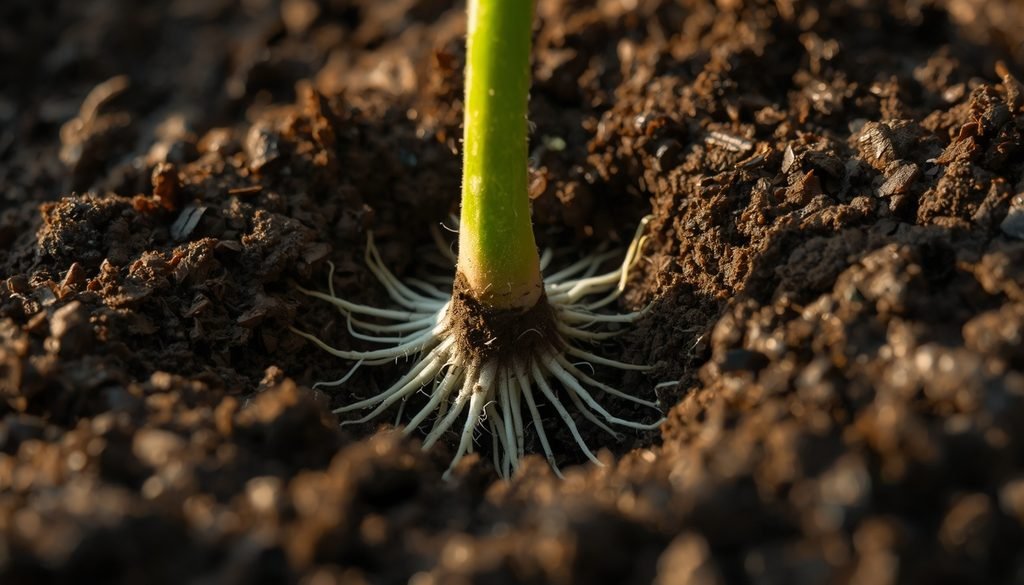
When a tomato seed germinates, the radicle emerges first and becomes the primary root, sometimes called the taproot. Left undisturbed in open soil, historical research recorded this young taproot elongating at roughly one inch per day under favorable conditions. In practice, most nursery grown and home started seedlings have this primary root disturbed during transplanting from a seed tray, which is not harmful; it redirects the plant’s energy into producing numerous lateral roots branching outward from the base of the buried stem.
Along any section of stem that ends up buried in soil, tomatoes readily form adventitious roots, roots that arise from stem tissue rather than from an existing root. This trait is a defining feature of the species and the reason deep planting at transplant time is a widely used technique.
Fine roots and root hairs at the tips of the finest branches do most of the actual water and nutrient absorption. University of Arizona extension guidance on vegetable crop root systems describes these fine root hairs as the most physiologically active part of the entire root system, and notes that a plant needs to continuously generate fresh young roots and root hairs to keep uptake efficient throughout the season.
Because of this branching lateral network, a mature tomato plant’s root system is frequently wider than it is deep. Historical excavation research by Weaver and Bruner (University of Nebraska, 1927) found that a young “John Baer” variety plant, about one month in the field, reached roughly two feet in depth with a maximum lateral spread of 24 inches, with the bulk of the densely branched lateral roots concentrated between about two and ten inches deep. Treat the tomato root system as a wide, branching network doing most of its daily work near the surface, not as a single deep taproot.
Tomato Root Growth From Seed to Mature Plant
Root development follows a general, well documented progression, though it does not follow a fixed universal schedule that applies identically to every cultivar, soil, and climate. The stages below describe a practical developmental sequence rather than measured weekly depths.
Radicle emergence and early primary root growth. Within days of germination, the radicle breaks through the seed coat and grows downward ahead of the visible shoot, elongating rapidly under good moisture and temperature.
Lateral root formation. As the primary root extends, lateral roots begin emerging from tissue just inside the root’s outer surface, a process known to be stimulated by the plant hormone auxin and accelerated once the seedling is established.
Transplant disturbance and recovery. Moving a seedling from a tray to a larger container or the garden disturbs the young root system. This is normal and, at the right seedling stage, promotes a denser fibrous system rather than reliance on a single primary root.
Deep planting and adventitious rooting. Because of the stem’s rooting ability, seedlings benefit from being planted deeper than they sat in the nursery pot, with lower leaves removed and the stem buried up to the first remaining set of true leaves, producing additional roots along the buried section.
Establishment through fruiting. As the plant grows toward flowering and fruiting, its root system continues expanding within its effective zone and, where soil allows it, extends opportunistically deeper in search of moisture during dry periods. This is a continuous process rather than a series of fixed depth milestones, and its extent depends heavily on soil structure, watering practice, and cultivar vigor.
How Deep Do Tomato Roots Grow in Garden Soil?
This is where clarity between three separate measurements matters most.
Effective root zone. University of Arizona extension guidance defines the effective root zone as the depth of soil that the bulk of a plant’s root system actually uses for water and nutrient uptake, distinct from the maximum depth roots are capable of reaching. As a general pattern for vegetable and field crops broadly, that guidance and similar irrigation scheduling references (Texas A&M AgriLife, North Carolina State Extension) describe roughly 70 percent of water and nutrient uptake occurring in the top half of the effective root zone, with steadily less from progressively deeper soil. This is a general vegetable and field crop irrigation guideline, not a tomato specific measurement, and it should be read as a description of typical uptake patterns rather than a tomato biology fact.
Common practical depth. For home grown tomatoes in typical garden soil, most horticultural sources converge on an effective root depth of about 18 to 24 inches (46 to 61 cm), with the densest lateral root mass often within the top 6 to 12 inches (15 to 30 cm). Treat this as a practical planning range for soil preparation, not a fixed biological ceiling.
Documented maximum penetration. Weaver and Bruner’s excavation research recorded a mature field grown tomato plant with a working root depth of about three feet and a maximum penetration of 49 inches in deep, loose Nebraska soil, with roughly 65 cubic feet of soil already explored by roots at that point in the season. A separate lateral root in that same study grew outward roughly three feet from the plant base before turning downward and reaching 45 inches deep. These are historical measurements of the species’ genetic potential under favorable, uncompacted, deep soil conditions. They describe what is possible, not what a typical backyard tomato in average garden soil will achieve.
Practical takeaway: prepare soil to at least 18 to 24 inches of loose, well drained depth, and treat any additional depth the plant reaches on its own as a bonus it will use opportunistically during dry periods, rather than something you need to engineer directly.
Tomato Root Depth in Raised Beds
Raised bed depth interacts with whatever soil lies beneath the bed. If the native soil underneath is loose and well drained, roots can pass through the bed’s imported soil and continue into the ground below, meaning a shallower bed can still support a well rooted plant. If the underlying soil is compacted, rocky, or heavily clay based, the bed effectively becomes the entire usable root zone, and its depth becomes far more important.
For that reason, a bed built directly over compacted subsoil should aim for at least 18 to 24 inches of quality growing medium to match the common practical root depth described above, while a bed built over already loose, well draining native soil can perform adequately with somewhat less imported depth, since roots are not confined to the bed alone. Checking the soil beneath a planned bed site with a simple probe or shovel test before building is a more reliable guide than assuming a fixed bed depth will work everywhere.
Tomato Root Depth in Containers
Container growing changes the picture because the container imposes a hard physical limit that garden soil does not.
Once roots reach the bottom or sides of a container, they either shift toward lateral branching or begin circling along the wall. University of Maryland Extension guidance on container vegetables recommends matching container size to both the top growth and root system of the plant, considering depth and total volume together, and specifically advises against squeezing large vegetables into small containers. That guidance lists a minimum of roughly 8 to 10 gallons and 12 to 16 inches of depth for large single vegetable plants such as tomato, pepper, and cucumber.
Other extension sources describe somewhat different minimums depending on the tomato type. Iowa State University Extension and Outreach recommends at least a 2 gallon, roughly 10 inch diameter container for cherry tomatoes, and at least a 4 gallon, 12 to 14 inch diameter container for standard tomatoes. University of Wisconsin Extension, Marinette County, states that indeterminate varieties need more room than a standard 5 gallon bucket, while determinate varieties can perform adequately in a 5 gallon bucket. These figures do not agree exactly, which reflects the nature of horticultural guidance rather than a single fixed biological requirement, so the table below presents a range drawn from these sources rather than one authoritative number.
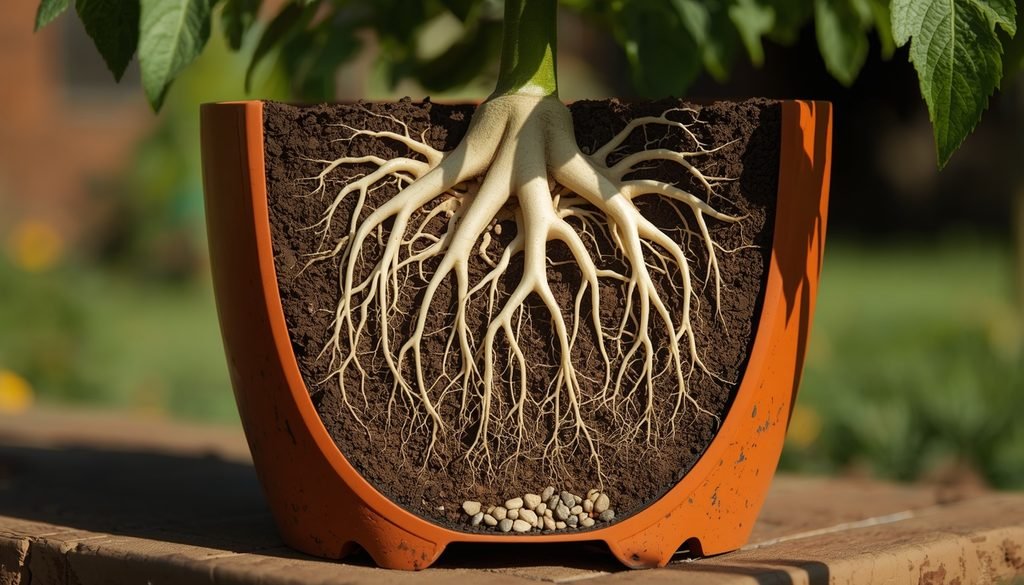
Containers without adequate drainage holes encourage waterlogged conditions exactly where restricted roots tend to accumulate, raising the risk of root rot in containers more than in open garden soil. Because a container holds a finite volume of soil, it also dries out faster than garden soil, particularly in warm weather, which is why containerized tomatoes typically need more frequent watering attention even though deep, less frequent watering remains the better long term approach.
| Tomato Type Practical Depth Range Typical Container Volume Source Basis | |||
|---|---|---|---|
| Cherry / dwarf tomatoes | 10 to 12 in (25 to 30 cm) | 2 to 4 gallons (about 8 to 15 L) | Iowa State University Extension and Outreach |
| Compact / patio tomatoes | 12 to 14 in (30 to 36 cm) | 3 to 5 gallons (about 11 to 19 L) | Bred for restricted root volume; benefits from more room where available |
| Determinate (bush) tomatoes | 12 to 16 in (30 to 41 cm) | 5 to 10 gallons (about 19 to 38 L) | University of Wisconsin Extension, Marinette County; University of Maryland Extension |
| Indeterminate tomatoes | 16 to 20 in (41 to 51 cm) | 10 to 15 gallons (about 38 to 57 L) | University of Wisconsin Extension, Marinette County |
| Very vigorous indeterminate / large heirloom types | 18 to 24 in (46 to 61 cm) | 15 to 20+ gallons (about 57 to 76+ L) | Extrapolated above extension minimums for large single vegetable plants; not a fixed limit |
Tomato Roots in Fabric Pots
Fabric pots are porous, allowing air to reach root tips near the container’s edge. University of Florida IFAS Extension documentation on fabric container tree production describes a real mechanism called air pruning, in which a root tip exposed to air through the fabric slows its growth, prompting the plant to branch additional roots further back rather than continuing to circle along a solid wall.
That same extension source notes that published research on plant growth outcomes in fabric container systems is limited, and most of the existing air pruning research comes from woody nursery tree production rather than controlled trials on vegetable annuals such as tomato. This revision therefore describes air pruning as a documented, plausible mechanism that reduces circling and root bound conditions, without claiming a specific, quantified improvement in tomato root mass or yield, since no controlled tomato specific study of that magnitude was located.
The practical trade off is water loss: fabric pots generally dry out faster than an equivalent rigid container because moisture escapes through the porous walls, so they typically need more frequent watering. Sizing guidance for depth and volume still applies to fabric pots exactly as it does to rigid containers.
Determinate Versus Indeterminate Tomato Root Systems
Determinate tomatoes grow to a genetically predetermined size, set most of their fruit within a relatively short window, and then decline. Indeterminate tomatoes continue growing, flowering, and fruiting until frost or disease ends the season.
No extension or research source located assigns a fixed root depth number to either growth habit. What does change is the practical demand on the root system: an indeterminate plant’s continued vegetative growth places ongoing demand on water and nutrient uptake throughout the season, which is why container guidance consistently recommends more root volume, not necessarily dramatically more depth, for indeterminate types. Growth habit alone does not set root depth; soil conditions and container size still govern the outcome more than determinate versus indeterminate status by itself.
How Deep Do Cherry Tomato Roots Grow?
Small fruit size does not predict root system size. Cherry tomatoes span two very different growth habits: compact, often determinate varieties bred specifically for containers and small spaces, and vigorous indeterminate cherry varieties that can grow as large as, or larger than, standard slicing tomato plants.
A compact cherry variety performs well in the smaller container range described above. A vigorous indeterminate cherry variety needs the same container volume and depth consideration as any other indeterminate tomato, since its root system responds to overall plant vigor and season length, not to the eventual size of its fruit.
Tomato Versus Cucumber Versus Pepper Root Depth
Home gardeners frequently compare tomato roots with two other common crops grown nearby. The maximum effective rooting depth figures below come from an agricultural engineering irrigation reference table (data compiled by Martin et al., 1990, used for irrigation scheduling), which describes potential depth under well managed field production rather than typical home garden performance.
| Crop Maximum Effective Root Depth (Irrigation Engineering Reference) Typical Root Behavior Container Considerations | |||
|---|---|---|---|
| Tomato | Approximately 2.3 to 5.0 ft (0.7 to 1.5 m) | Taproot tendency giving way to a dense, wide lateral network; strong adventitious rooting from buried stem | Benefits from both depth and volume; deep planting at transplant is especially useful because of adventitious rooting |
| Cucumber | Approximately 2.3 to 4.0 ft (0.7 to 1.2 m) | Fibrous system with wide lateral spread; more sensitive to root disturbance during transplanting than tomato | Prefers wide, moderately deep containers; minimize root disturbance when transplanting |
| Pepper | Approximately 1.7 to 3.3 ft (0.5 to 1.0 m) | Generally shallower and less extensive than tomato; historical excavation data shows lateral roots often turning downward into the second or third foot rather than spreading as widely | Slightly shallower container depth than tomato is workable, but similar volume considerations apply |
Important qualification: every figure in this table describes a maximum potential range under favorable, well managed conditions, not an average outcome. Actual root depth for any of these three crops in a specific garden depends on soil texture, irrigation practice, cultivar, temperature, and whether the plant grows in open ground, a raised bed, or a container. Use this table to understand relative tendencies between the three crops rather than as a prediction of what a specific plant will do.
How to Encourage Healthy Tomato Root Growth
Step 1: Prepare the soil before planting. Loosen soil to at least 12 to 18 inches (30 to 46 cm) where feasible, and work in compost or aged organic matter to improve both structure and nutrient availability.
Step 2: Correct compaction issues first. If a test hole meets firm, consistent resistance within the top 18 inches, address that compaction through deep tilling, broadforking, or repeated organic matter additions before planting, rather than planting into a compacted layer and hoping roots find a way around it.
Step 3: Transplant deeply. Remove the lower leaves from the seedling and bury the stem up to the first remaining set of true leaves, using the tomato’s adventitious rooting ability to establish a larger early root system than shallow transplanting produces.
Step 4: Water deeply and adjust to conditions. Once established, water thoroughly enough to moisten the soil to at least 8 to 12 inches deep, then allow the top couple of inches to dry before watering again, adjusting frequency for soil type, container size, and weather.
Step 5: Maintain drainage and add mulch. Confirm that beds and containers drain well, and apply a few inches of organic mulch over the root zone to moderate soil temperature and moisture swings, supporting steadier root activity through the season.
Tomato Root Oxygen, Drainage, and Soil Compaction
Roots are living tissue and require oxygen for respiration, just as the plant’s above ground tissue does. When soil is waterlogged, water displaces the air that would otherwise fill the pore spaces between soil particles, and roots sitting in that saturated zone can begin to suffocate, which opens the door to root rot pathogens.
Compaction reduces the pore space available for both air and water movement, limiting how deeply and densely roots can grow, and forcing roots to expend more energy penetrating the soil at all. No single universal soil oxygen percentage applies broadly enough across soil types and climates to state as a fixed fact, so none is asserted here. The practical takeaway is that loose, well aggregated, well drained soil supports deeper and healthier rooting than compacted or waterlogged soil, regardless of the exact number involved. Detect compaction with a simple test: push a garden trowel or a length of rebar into moist, not wet, soil, and note the depth where you meet firm, consistent resistance.
How to Water Tomatoes for Better Root Development
Moisture distribution genuinely influences where roots concentrate, since roots proliferate where moisture is reliably available and decline where it is consistently absent. The degree of that effect depends on soil texture, container size, rainfall, and temperature, so a single universal watering rule does not apply everywhere.
Use a decision based approach rather than a fixed schedule:
- In garden soil, check moisture at several inches depth before watering, and water deeply enough to moisten the top 8 to 12 inches when you do water, then wait until that zone begins to dry.
- In raised beds, follow the same approach as garden soil, adjusting frequency if the bed drains faster than native ground, which raised beds often do.
- In containers, check moisture more frequently, since containers dry out faster than garden soil, but still water thoroughly rather than with frequent small amounts.
- In fabric pots, expect faster drying than an equivalent rigid container, and check moisture correspondingly more often.
- In hot weather, increase monitoring frequency, since evapotranspiration rises with temperature and container soil in particular can dry within a single day.
- In rainy weather, reduce or pause supplemental watering and prioritize checking drainage, since the greater risk during extended wet periods is waterlogging rather than drought.
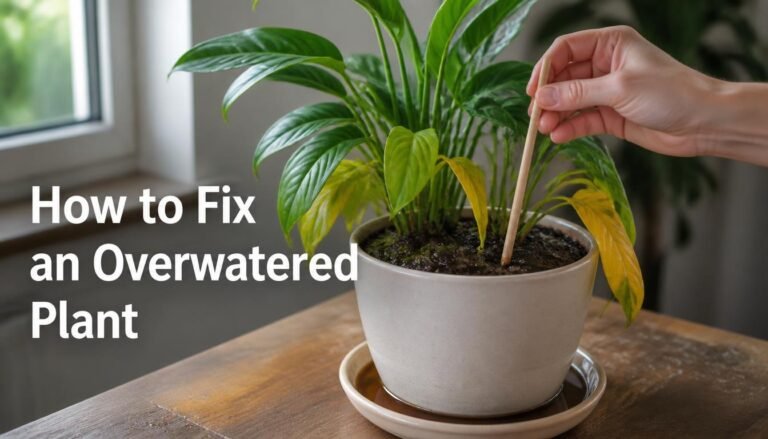
Watch for signs of overwatering, such as persistent wilting in saturated soil, yellowing lower leaves, or a sour smell near the root zone, which point toward oxygen deficiency rather than a need for more water.
Tomato Root Bound Symptoms
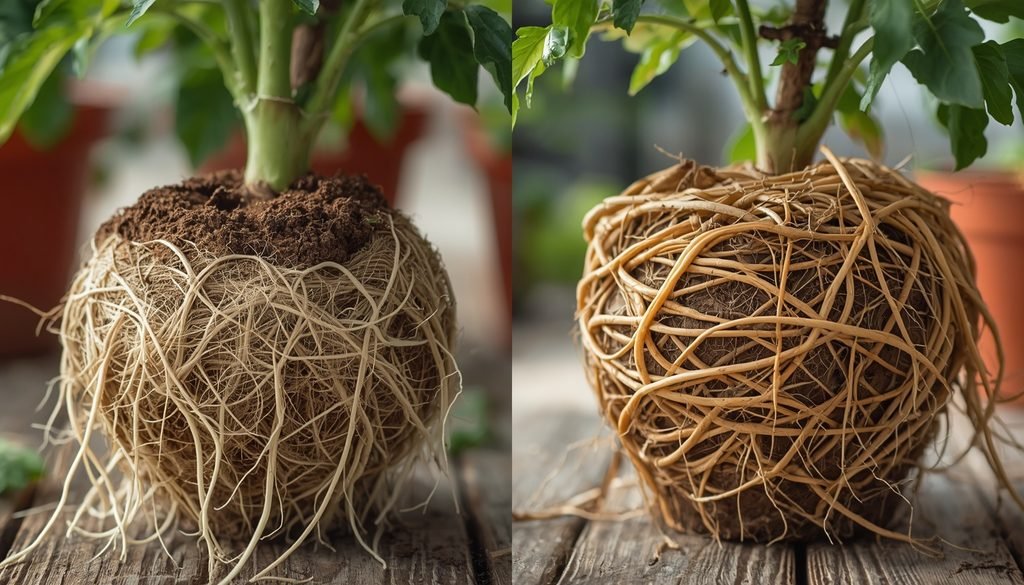
A root bound tomato has outgrown its container, and its roots have begun circling the inside of the pot instead of continuing to branch outward.
Symptoms include roots visible at the surface or emerging from drainage holes, stunted growth despite adequate feeding, increased watering needs, and a dense root mat with little visible soil when the plant is removed from its container.
Diagnosis: gently remove the plant from its pot and examine the shape of the root mass. A healthy young root system shows roots radiating outward through visible soil. A root bound system shows roots circling the outer edge in a tight pattern with little soil visible between them.
Correction: move the plant to a larger container as soon as circling roots appear, rather than waiting for stunted growth to develop. Gently tease apart the outer layer of circling roots before repotting, or, for a more established root ball, make a few shallow vertical scores around the outside with a clean knife to encourage roots to grow outward instead of continuing to circle. Avoid heavy root disturbance on a plant that is already flowering or fruiting, since aggressive handling at that stage can add transplant shock on top of an existing problem.
Tomato Root Rot Symptoms
Root rot differs from ordinary temporary wilting in both cause and pattern. Temporary wilting from heat or brief underwatering typically resolves within hours of watering or as temperatures cool in the evening, and the plant returns to a normal appearance without other symptoms.
Root rot, by contrast, typically follows prolonged saturation or poor drainage and presents as wilting that does not resolve even when soil is already wet, combined with yellowing of lower leaves, stunted or stalled growth, and, on inspection, roots that are dark brown to black, soft, or mushy rather than firm and pale, sometimes accompanied by a sour or rotten smell. If wilting persists despite consistently moist or wet soil, inspect the roots directly rather than assuming the plant needs more water.
Hydroponic Tomato Root Systems
In hydroponic production, conventional soil depth is not a meaningful metric, since there is no soil profile for roots to explore. The relevant variables instead are root zone volume within the growing system, dissolved oxygen concentration in the nutrient solution, the substrate or growing medium used, nutrient solution concentration and delivery, root zone temperature, and how effectively the system moves water and oxygen past the root surface.
Hydroponic tomato roots tend to form a dense, fine, highly branched mass adapted to constant water and nutrient availability, rather than the deeper penetrating pattern seen in soil where roots must actively seek out moisture. Maintaining adequate dissolved oxygen in the nutrient solution is critical, since roots suspended in water or a soilless medium can suffocate as quickly as roots in waterlogged soil if oxygen levels drop.
Companion Plants and Tomato Root Competition
Any two plants growing close together compete to some degree for water, nutrients, and, depending on canopy size, light. Densely rooted or fast growing neighbors can measurably reduce the water and nutrients available to a tomato’s root zone, particularly in a small raised bed or container where root volume is already limited. This general resource competition is well established plant biology, distinct from specific companion planting claims.
Most specific tomato companion pairing claims repeated in gardening folklore, such as particular herbs improving tomato flavor or repelling particular pests through simple proximity, are not supported by controlled research located during this review. Treat those pairing claims as unverified tradition rather than established fact, while still recognizing that general resource competition between closely spaced plants is real and worth managing through adequate spacing.
What Should Never Be Planted Near Tomatoes?
The most well documented answer involves black walnut trees (Juglans nigra). Black walnut produces a compound called juglone in its roots, hulls, and other tissue, and tomatoes are considered particularly sensitive to it.
Michigan State University Extension recommends not planting tomatoes within 50 to 70 feet of a black walnut tree, since contact between tomato and walnut roots can cause the tomato plant to decline and die. University of Wisconsin Extension plant pathology guidance describes juglone toxicity symptoms as wilting, yellowed or twisted leaves, stunted growth, and eventual death, sometimes appearing within days of a sensitive plant being transplanted into a walnut tree’s root zone, with toxic effects potentially extending 50 to 80 feet from the trunk depending on tree size.
An important qualification, drawn from Iowa State University Extension and Outreach guidance citing a Washington State University literature review, is that comparatively little controlled research demonstrates consistent juglone impact under actual garden soil conditions, as opposed to laboratory settings. Some plants presumed sensitive to juglone may in fact be struggling from the dry soil and heavy shade common under any large, established tree, rather than from juglone specifically. The practical recommendation to keep tomatoes well away from black walnut roots remains sound, but the certainty of juglone as the specific mechanism in every reported case is less firmly established than popular gardening advice often implies.
It is also standard practice not to plant tomatoes, peppers, potatoes, or eggplant in the same soil in consecutive years, since these related nightshade family crops share several soilborne diseases and pest pressures. This is a disease and pest management practice through crop rotation, separate from the juglone allelopathy question.
Do Tomatoes Need Mycorrhizal Fungi?
Tomatoes form partnerships with arbuscular mycorrhizal fungi, a type of soil fungus that extends fine threads into surrounding soil, increasing the effective area from which a plant can absorb water and phosphorus, in exchange for sugars from the plant. A 2023 peer reviewed field study by researchers at the University of Kansas, published in Microorganisms, found that native mycorrhizal fungi inoculation produced a measurable, though modest, yield benefit in field grown tomatoes under organic conditions, with roughly 10 percent greater fruit biomass driven mainly by an increase in fruit number.
However, a 2026 University of Connecticut Extension article cautions that this does not translate directly into a recommendation for commercial inoculant products in typical home gardens. That guidance notes that many established garden beds already host functional resident mycorrhizal communities, that a meta-analysis found a large share of commercial inoculant treatments resulted in minimal or no actual root colonization, and that high soil phosphorus, common in long cultivated vegetable gardens, reduces a plant’s reliance on the fungal partnership regardless of what is applied. Some common garden crops outside the tomato family, such as brassicas and beets, generally do not form these partnerships at all.
Practical takeaway: mycorrhizal fungi are a real and potentially useful partnership for tomatoes, particularly in disturbed or previously sterile growing media, but routine purchase of a commercial inoculant is not established as necessary for an ordinary, already cultivated home vegetable garden. A soil test and attention to phosphorus levels is a more evidence based first step than adding a packaged inoculant by default.
Frequently Asked Questions
Do tomatoes have very deep roots?
Not typically. Most tomato roots concentrate in the top 18 to 24 inches of soil, functioning as a wide, branching network rather than a single deep taproot. Under loose, deep soil conditions, historical research has documented roots reaching several feet, but that depth is opportunistic, not the norm for an average garden plant.
What should never be planted near tomatoes?
Black walnut trees are the clearest documented risk, since their roots release juglone, a compound linked to wilting, decline, and death in tomato plants. Extension guidance recommends keeping tomatoes at least 50 feet from a mature black walnut, though some research suggests factors beyond juglone alone, such as shade and dry soil, may also contribute in specific cases.
How deep soil to grow tomatoes?
Aim for at least 18 to 24 inches (46 to 61 cm) of loose, well drained soil for in ground or raised bed tomatoes. This depth covers the effective root zone responsible for most water and nutrient uptake, even though a portion of roots may travel deeper where soil conditions allow it.
How deep do tomato roots grow in pots?
Container tomato roots are limited by the pot itself, typically ranging from 10 to 12 inches for cherry and dwarf varieties up to 18 to 24 inches for large indeterminate types in appropriately sized containers.
How deep do cherry tomato roots grow?
Compact cherry varieties can perform well in containers around 10 to 12 inches deep, but vigorous indeterminate cherry varieties need the same root volume as any large indeterminate tomato, since fruit size does not determine root system size.
How do you know if a tomato plant is root bound?
Look for roots circling the inside of the pot or emerging from drainage holes, stunted growth despite regular feeding, and a dense root mat with little visible soil when the plant is removed from its container.
How often should tomato plants be watered?
Rather than a fixed schedule, water when the top few inches of soil begin to dry, applying enough water to moisten the root zone deeply each time, adjusting frequency for container size, soil type, and weather.
How deep should a raised bed be for tomatoes?
At least 18 to 24 inches of quality growing medium when the bed sits over compacted or poor native soil. A bed built over already loose, well draining ground can perform adequately with somewhat less depth, since roots can extend into the soil beneath the bed.
How deep should tomato seedlings be planted?
Bury the stem up to the first set of remaining true leaves, removing lower leaves first. This uses the tomato’s adventitious rooting ability along the buried stem to build a stronger early root system than shallow transplanting.
Conclusion
Tomato roots do not follow a single fixed number, and treating any one figure as universal oversimplifies a genuinely variable biological process. The evidence supports a clear, usable structure instead: expect the bulk of a tomato’s active root system within 18 to 24 inches of the surface in garden soil, expect real but opportunistic deeper growth in loose, well managed ground, and expect container roots to be shaped directly by whatever depth and volume you provide. Understanding the difference between effective root zone and maximum potential depth, and knowing which of a source’s numbers describes which one, is the most useful tool for deciding how much soil depth your tomatoes need, what container to choose, and how to diagnose a struggling plant before it fails.
For related guidance on getting soil and container conditions right from the start, PlantySolve covers how to improve garden soil drainage, choosing the right vegetable container size, preventing tomato root rot, improving compacted garden soil, how to water vegetable plants correctly, raised bed soil preparation, a broader vegetable root health guide, and a container gardening soil guide for readers setting up a new pot or raised bed this season.

4 Comments