How to Propagate Pothos : complete guide (2026)
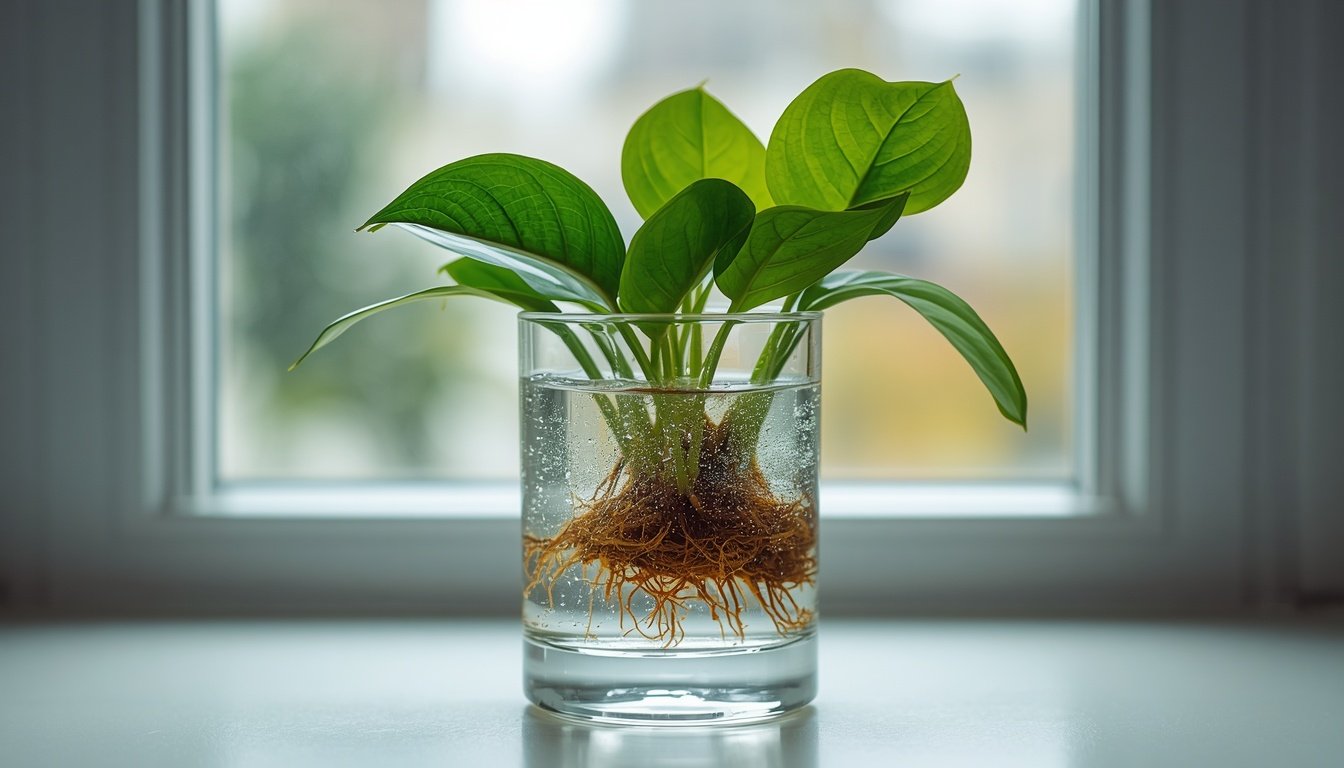
Quick answer: To propagate pothos, cut a healthy vine 3 to 6 inches long just below a node, keeping at least one leaf and ideally two or three nodes. Place the node in clean water or bury it in moist, well-draining mix. Give warm, bright, indirect light, wait for roots about 1 inch long, then move water-rooted cuttings into soil.
Quick diagnosis: what is going wrong with your cutting?
| Problem or Situation | Likely Cause | Practical Fix |
|---|---|---|
| No roots after several weeks | Cold room, low light, no node in the water or mix, or an unhealthy cutting | Confirm a node is covered, move to a warmer and brighter spot, and recut above any dead tissue |
| Stem is mushy or dark | Rot, often from stagnant water, contaminated tools, or a buried leaf | Cut above the soft area with clean tools, discard rotted parts, and restart in fresh water |
| Leaves yellowing | Leaf underwater, low light, or a stressed cutting | Remove submerged leaves and improve light. Check whether the yellow leaves are the ones touching the water |
| Cutting is wilting | Dry air, no roots yet to replace lost water, or the rooting medium dried out | Keep the medium moist, raise humidity, and avoid direct sun |
| Roots are slow | Cool temperature or dim light | Warm the cutting, brighten the location, and be patient |
| Leaves underwater | Cutting placed too deep | Trim off the submerged leaves or lift the cutting so only the node and stem are submerged |
| Cutting drying out in water | Water evaporated and exposed the roots | Top up water so the roots stay covered |
| Roots developed but plant struggles after potting | Water-formed roots adapting to soil | Keep the mix evenly moist, use bright indirect light, and allow a few weeks to recover |
What you need
- A healthy pothos vine with several leaves and visible nodes
- Clean, sharp scissors or pruners
- A clear glass or jar for water propagation
- A container at least 2 inches deep with drainage holes, plus a rooting mix, for soil propagation
- Perlite, if you are mixing your own medium
- Optional: rooting hormone, a clear bag or dome, and a heat mat
Iowa State University Extension lists perlite as a rooting medium with good drainage and aeration, and it notes that regular potting soil should only be used as part of a mix because it often does not provide enough drainage or aeration. Rooting hormone is optional for pothos. Extension guidance also warns that too much can slow root development.
Where the node is
What a node is
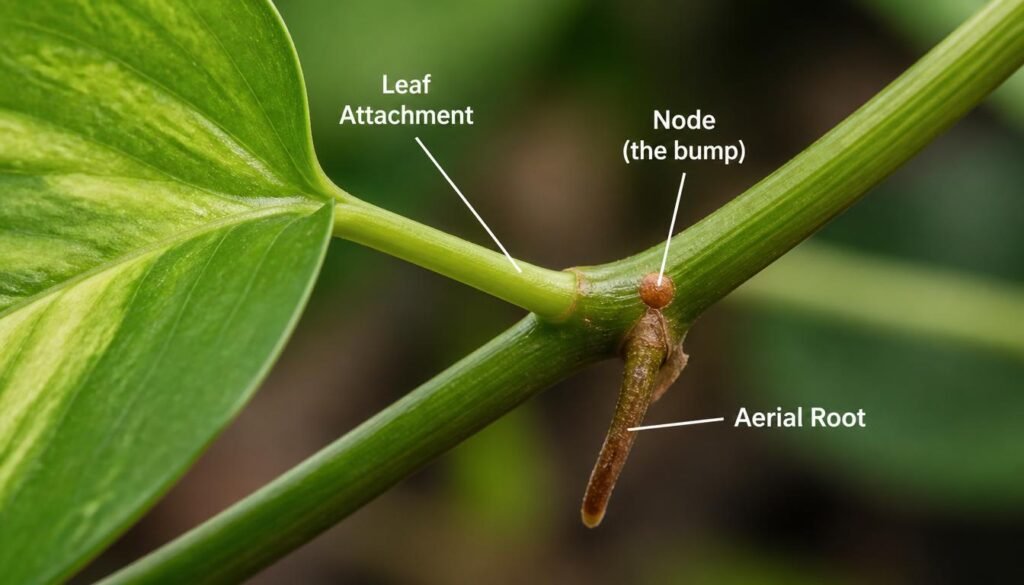
A node is the slightly raised point on a pothos stem where a leaf attaches. Between nodes, the stem section is called the internode. On a pothos vine, the node is also where a leaf bud sits and where a downward-pointing aerial root usually appears. Plant patent descriptions for University of Florida pothos cultivars record one aerial root at each stem node, and note that these roots produce fine roots when they contact soil.
How to find it
Look at the underside of the vine where each leaf joins the stem. The node is the small bump or ring at that joint, often with a short brown root nub beside it. If a leaf has fallen off, a bare node still shows as a bump with a small scar.
Why the node matters
New roots and new shoots form from the node region. A section of stem with no node has no place to make either. Commercial pothos production uses stem cuttings with a node and an attached leaf, according to University of Florida IFAS.
What goes where
- Node goes into water or mix. At least one node must be covered.
- Leaves stay above the water or mix. Buried or submerged leaves rot.
- Aerial roots can go under too. If a node already has an aerial root, that root can be placed in the water or mix.
If there is no viable node
A leaf with a petiole and no stem node will not grow into a new vine. It may stay green for a while, but no extension source reviewed describes pothos being propagated from a leaf alone. Recut from a section that includes a node. A leaf with a small piece of stem that includes a node does count as a node cutting.
How to cut pothos for propagation
Pick a healthy, actively growing vine. Iowa State University Extension advises watering the parent plant the day before so the stems and leaves are fully hydrated, and says stem cuttings should be 3 to 6 inches (about 7.5 to 15 cm) long with at least two nodes.
Cutting size and node guidance
| Cutting type | What it is | Notes |
|---|---|---|
| Single node with one leaf | One node and its leaf | Used commercially under controlled conditions. At home it has less margin for error |
| Two to three nodes with two or more leaves | A short vine tip or section | The most forgiving choice for beginners and matches extension guidance |
| Long vine | Several nodes | Cut into shorter pieces, each with a node and leaf, so more plants come from one vine |
Step by step
- Choose the vine. Pick a healthy stem with green, firm tissue and several leaves. Avoid stems with soft spots.
- Clean the tool. Wipe the blades with rubbing alcohol or wash them. Bacteria can enter through cut wounds during propagation, and University of Florida IFAS records bacterial wilt in pothos production at the single-node rooting stage.
- Find the node. Locate the node where a leaf meets the stem.
- Cut just below the node. Cut about 1 cm (roughly half an inch) below it. Keep the cut short so no long bare tail remains that can rot. An angled cut helps you remember which end is down. Iowa State notes that stem segments will not root upside down.
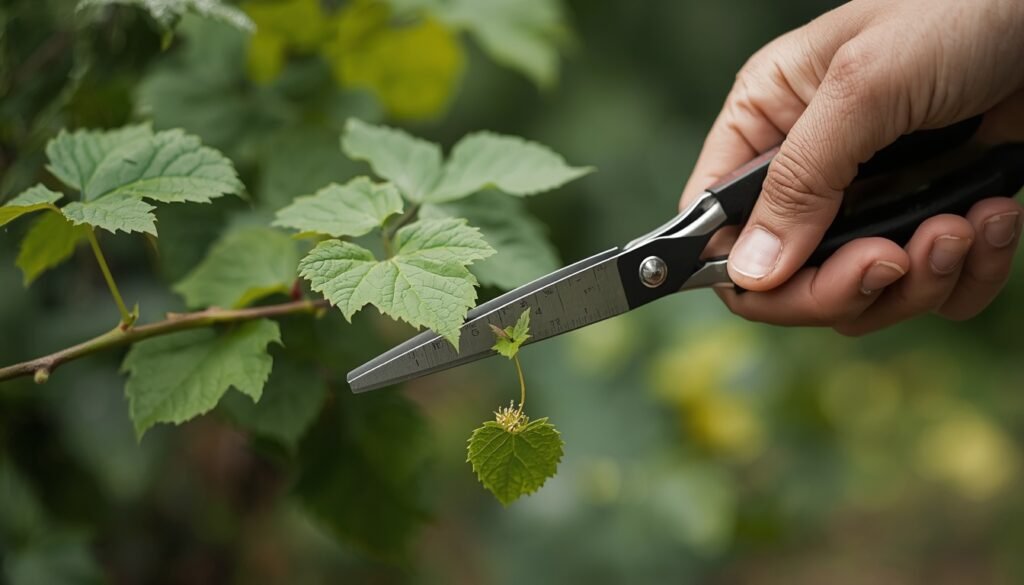
- Remove the leaf nearest the cut end. Take off the lowest leaf so that one node and no leaf will sit in the water or mix. Keep at least one leaf at the top.
- Cut fast, then root fast. Process cuttings quickly. If you must wait, Iowa State suggests wrapping the cut ends in a moist paper towel and storing them cool and out of bright light.
What can go wrong: cutting mid-internode with no node, leaving a long stub, or using dirty blades.
How to propagate pothos in water
To propagate pothos in water, place the node of a cutting in clean water, keep the leaves dry, and change the water one to two times per week until roots are about 1 inch (2.5 cm) long.
Water propagation lets you see roots form and needs no potting mix. Its main limit is that roots formed in water are coarser and less adapted to soil, which is why some cuttings struggle after potting (Iowa State University Extension).
Step by step
- Prepare a clean container. Use a clear glass or jar that holds the cutting upright. Wash it first.
- Add room-temperature water. Fill enough to cover the lowest node. Leaves must stay above the water.
- Place the cutting. Set the node underwater and keep every leaf out of the water. Look for: a node fully covered and no leaf touching water. Risk: submerged leaves rot and foul the water.
- Choose the light. Put the jar in a spot with bright, indirect light. Iowa State recommends 4 to 6 hours of bright indirect light for root and shoot growth. Direct sun can burn foliage, and too little light slows root formation and can lead to rot.
- Keep it warm. Air temperature between 65 and 75 degrees F (about 18 to 24 degrees C) is described as ideal for cuttings in extension guidance. Cold rooms slow rooting.
- Change the water. Change it one to two times per week and never let the level drop enough to expose the roots. Look for: clear water and white or cream roots. Risk: cloudy, foul water and slimy tissue signal rot.
- Wait for roots about 1 inch long. Iowa State advises transplanting when roots are about 1 inch (2.5 cm) long.
How to propagate pothos in soil
To propagate pothos in soil, bury at least one node in moist, well-draining mix, keep it warm and bright, and maintain humidity with a loose cover until roots form.
Cuttings can root directly in a medium without first growing roots in water. Roots that form in a medium develop in that medium, so they are already adapted to it, while water-formed roots are coarser and may show stress after potting (Iowa State University Extension). Soil propagation also skips the transplant step.
Step by step
- Prepare the container. Use a clean pot with drainage holes, at least 2 inches deep.
- Prepare the medium. Use a well-draining mix, for example potting mix blended with perlite. Moisten it before use, water it, and let it drain for a few minutes.
- Make a hole. Use a pencil or chopstick so the stem is not scraped as it goes in.
- Insert the cutting. Bury at least one node and no leaves. Firm the mix so the cutting stands upright. Look for: a stable cutting with leaves clear of the surface. Risk: buried leaves rot.
- Treat the cut end if you choose. Rooting hormone is optional. Use a small amount in a separate container and never dip cuttings into the original jar, since disease can spread that way.
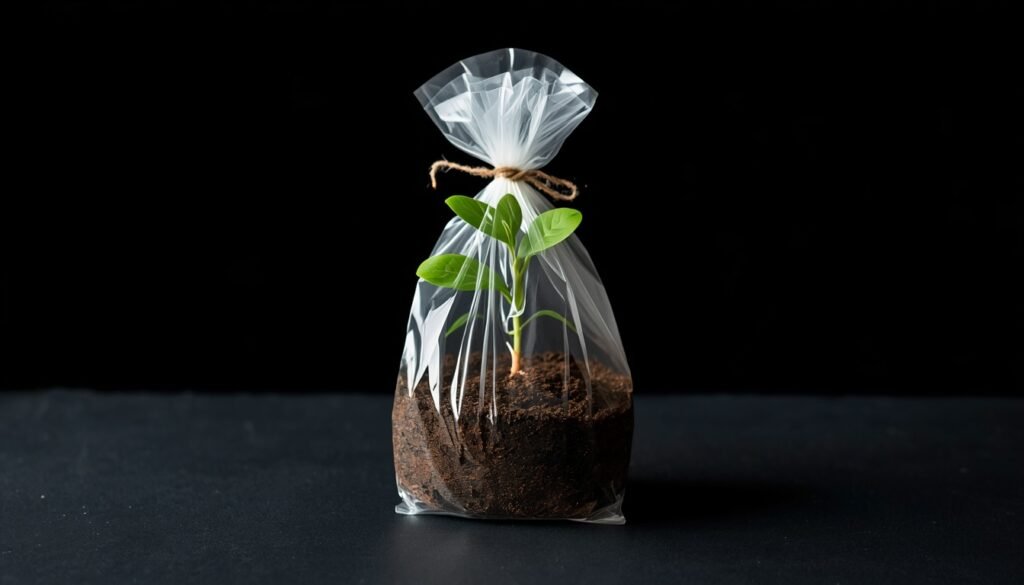
- Provide humidity. Enclose the pot in a loose clear bag or dome, held off the leaves with supports, and do not seal it tightly. Iowa State describes high humidity as essential for rooting and says the bag should allow air exchange. Open it regularly to check moisture, and keep it out of direct sun, which can burn leaves under a cover.
- Keep it moist, not soggy. Moisten the mix if it feels dry. Risk: constantly saturated mix can rot the buried node.
- Give bright indirect light and warmth. Same range as for water cuttings.
- Test gently after several weeks. A light tug that meets resistance may suggest roots. New leaf growth also signals rooting.
Perlite can also serve as the rooting medium because it balances drainage and air. Coarse sphagnum moss holds more moisture but is hard to re-wet if it dries out completely (Iowa State University Extension).
Water or soil: which should you choose?
Sources differ on which method is faster, and no method is universally better.
| Factor | Water | Soil or medium |
|---|---|---|
| Seeing roots form | Easy, through clear glass | Not visible |
| Root type | Coarser water roots | Roots formed in the medium |
| Transplant step | Needed, with a possible setback | None |
| Rot risk | Stagnant, unchanged water | Overwatering and poor drainage |
| Effort | Water changes | Moisture and humidity management |
| Best for | Beginners who want to watch progress | Anyone who wants to skip transplanting |
How long pothos cuttings take to root
Pothos cuttings typically form usable roots in about 3 to 6 weeks, though the range shifts with conditions. Iowa State University Extension says most houseplant stem cuttings root in 3 to 6 weeks. Plant patent descriptions for University of Florida pothos cultivars describe cuttings rooting in about 2 to 3 weeks in a shaded greenhouse.
| Stage | Typical window | What you should see |
|---|---|---|
| Settling | First week or so | Little visible change is common |
| First roots | Often within the first few weeks | Small root nubs at the node |
| Usable roots | About 3 to 6 weeks | Roots around 1 inch long |
| After potting | A few weeks (Iowa State) | New growth as the plant establishes |
Rooting speed depends on temperature, light, cutting health, node condition, season, medium or water conditions, cultivar, and stress. A published study on golden pothos single-node cuttings reported that warm medium (28 degrees C) and higher light improved shoot and root growth compared with cool medium and dim light.
Early spring is the ideal time to take cuttings, although most houseplants can be propagated successfully at any time of year (Iowa State University Extension). In a cool or dim season, extra warmth and light matter more.
When to move water cuttings into soil
Move a water-rooted cutting to soil when the roots are about 1 inch (2.5 cm) long (Iowa State University Extension). Some growers leave cuttings in water longer, but Iowa State advises potting at about 1 inch of root.
- Prepare the pot. Use a container with drainage and a moistened, well-draining mix.
- Make room for the roots. Do not bend or crush them.
- Set the cutting. Plant so the node and roots are covered and leaves stay above the surface.
- Water and let drain.
- Keep it evenly moist and bright. Iowa State advises keeping newly potted plants well watered in bright indirect light, and says plants are typically established within a few weeks.
For a fuller plant, pot several cuttings together. Commercial pothos production plants many cuttings per pot, for example 10 to 15 in a 15 cm pot in one University of Florida plant patent description, and one plant care guide suggests at least three or four cuttings to fill a pot or hanging basket.
Caring for new cuttings
- Light: bright, indirect. Too little slows rooting.
- Temperature: warm rooms suit rooting. A heat mat raising medium temperature to 75 to 80 degrees F (about 24 to 27 degrees C) is suggested for cuttings.
- Moisture: even moisture for soil cuttings and consistent water levels for water cuttings.
- Fertilizer: wait until the plant is established before regular feeding.
- Pet safety: pothos is generally listed as toxic if chewed.
Root division and layering
Root division is not the same as making a plant from a cutting. Division applies when one pot already holds a mass of rooted stems. Remove the root ball, gently separate stems along with their roots, and repot at the same soil level (Gardening Know How). Use division when repotting an overcrowded plant. Use stem cuttings when you are starting from a vine.
Layering is another option. Lay a stem on moist mix in the same pot or a nearby one while it is still attached, let it root, and then cut it free (Gardening Know How).
Variegated and colored pothos
Golden pothos and Marble Queen are selections of Epipremnum aureum, and the sources reviewed give one method for pothos in general. No source reviewed reports a different method by cultivar. University of Florida guidance for interior pothos says variegated cultivars lose color in low light, so give cuttings of variegated types bright, indirect light.
Troubleshooting
Why is my pothos cutting not rooting?
Cause: no node in the water or mix, cold conditions, dim light, or a weak cutting. Check: is a node covered, and is the room warm? Fix: recut below a healthy node, warm the cutting, and brighten its location. Prevent: use two or three nodes and keep the cutting in bright, indirect light.
Why is the stem turning brown?
Cause: rot, or drying at the cut end. Check: is the tissue firm or soft? Fix: recut above brown, soft tissue with clean tools. Prevent: use a clean tool and change water on schedule.
Why is the cutting getting mushy?
Cause: rot from stagnant water, buried leaves, or infection. University of Florida IFAS notes that bacteria can infect through wounds during propagation, and infected cuttings fail to root. Check: mushy or slimy stem, ooze at the cut, cloudy water. Fix: cut above the affected area, discard rotted parts, and restart in a clean container. Prevent: clean tools, clean containers, and no leaves under water.
Why are the leaves yellowing?
Cause: submerged leaves, low light, or stress. Check: which leaves yellow, and are any underwater? Fix: remove submerged or fading leaves and improve light. Prevent: keep leaves above water and in bright, indirect light.
Why are the leaves wilting?
Cause: the cutting loses water faster than it can take it up, since cuttings have limited water uptake without roots (Iowa State University Extension). Check: is the medium dry, the air very dry, or the light too strong? Fix: keep the medium moist, add a loose humidity cover, and move out of direct sun. Prevent: start with hydrated cuttings and avoid heat.
Why are the roots growing slowly?
Cause: cool temperatures or too little light. Check: room temperature and daily light. Fix: move to a warmer, brighter spot. Prevent: propagate in warm conditions when possible.
Can pothos root from a leaf alone?
No, not into a full plant. A leaf without a node lacks the tissue that forms shoots. Check: does the piece include a stem section with a node, or only a leaf and its petiole? Fix: cut a section that includes a node. Prevent: always include a node.
Can pothos root from a stem without leaves?
A leafless section with a node may root in some cases, but it has no leaf to support it and is less reliable. Check: is the node firm and green? Fix: use sections with a node and a leaf when possible. Prevent: keep at least one leaf on each cutting.
Can one node produce a new pothos plant?
Yes. Plant patent descriptions for University of Florida cultivars record single-node cuttings, and University of Florida IFAS reports commercial single-node rooting. At home, single-node cuttings have less margin for error, so consider two or three nodes when you can. Check: the node should be firm, with a healthy leaf attached.
What happens if the node is not in water or soil?
The node cannot produce roots in air. Check: is the node above the water line or the surface? Fix: lower the cutting so the node is covered. Prevent: check water levels regularly.
Why did the cutting rot after transfer to soil?
Cause: waterlogged mix, poor drainage, or a buried leaf. Check: is the mix constantly wet and are leaves in contact with it? Fix: repot into fresh, well-draining mix with drainage holes. Prevent: keep the mix evenly moist but not soggy.
Why did the cutting root in water but struggle in soil?
Cause: water roots are coarser and less adapted to soil, and may show wilting, leaf drop, browning, or tip die-back after potting (Iowa State University Extension). Fix: keep even moisture and bright indirect light. Prevent: transplant at about 1 inch of root, or root directly in a medium.
Common mistakes
- Cutting where there is no node
- Failing to include a viable node in the water or mix
- Submerging or burying leaves
- Using dirty scissors, jars, or pots
- Never changing the water
- Letting the water level drop and expose roots
- Placing cuttings in direct sun
- Using heavy potting soil with poor drainage
- Overwatering soil cuttings
- Planting upside down
- Moving a cutting to soil before it has any roots
- Letting a newly potted cutting dry out
Frequently asked questions
What is the absolute requirement for a pothos cutting to root?
A healthy stem section with at least one node, kept in contact with water or moist mix. Leaves should stay above the surface.
How do you properly cut the plant?
Use clean, sharp scissors and cut about 1 cm below a node. Keep the cutting 3 to 6 inches long, with at least one leaf and ideally two or more nodes. Remove the lowest leaf.
What are the main methods of propagation?
Stem cuttings rooted in water, stem cuttings rooted in soil or another medium, layering, and root division of a crowded plant. Division and layering are different from cuttings.
How long does it take for roots to appear?
Often within the first few weeks. Usable roots about 1 inch long commonly take 3 to 6 weeks, and cold or dim conditions can slow this.
When can you transplant water-propagated pothos into soil?
When roots are about 1 inch long. Keep the mix evenly moist afterward.
Can pothos propagate from a single node?
Yes, though two or three nodes are more forgiving at home.
Can pothos propagate without leaves?
A leafless node may root in some cases but is less reliable. A leaf with no node cannot make a new plant.
Can pothos propagate directly in soil?
Yes. Bury at least one node in moist, well-draining mix, keep it warm and bright, and maintain humidity with a loose cover.
Why is my pothos cutting rotting?
Common causes are stagnant water, submerged or buried leaves, contaminated tools, or waterlogged mix. Cut above the soft tissue and restart cleanly.
Should pothos cuttings be kept in direct sunlight?
No. Bright, indirect light is recommended. Direct light can burn foliage, especially under a cover.
Conclusion
Find the node, cut just below it, keep leaves out of the water or mix, and give the cutting warmth and bright, indirect light. Choose water if you want to watch roots form, or soil if you want to skip the transplant. If a cutting struggles, the troubleshooting section above will usually point to the cause.